
The Regulation requirements:
Occupational Health and Safety Act, 1993 (Act No. 85 of 1993) – General Safety Regulations
GSR 6 Work in elevated positions
No employer shall require or permit any person to work in an elevated position, and no person shall work in an elevated position, unless such work is performed safely from a ladder or scaffolding, or from a position where such person has been made as safe as if he were working from scaffolding.
GSR 13A Ladders
1. An employer shall ensure that every ladder is constructed of sound material and is suitable for the purpose for which it is used, and –
a) is fitted with non-skid devices at the bottom ends and hooks or similar devices at the upper ends of the stiles which shall ensure the stability of the ladder during normal use; or;
b) is so lashed, held or secured whilst being used as to ensure the stability of the ladder under all conditions and at all times.
2. No employer shall use a ladder, or permit it to be used, if it –
a)
- has rungs fastened to the stiles only by means of nails, screws, spikes or in like manner; or
- has rungs which have not been properly let into the stiles: Provided that in the case of welded ladder or ladders of which the rungs are bolted or riveted to the stiles, the rungs need not be let into the sides; or
b) has damaged stiles, or damaged or missing rungs.
3. No employer may permit that –
a) a ladder which is required to be leaned against an object for support be used which is longer than 9 m; and
b) except with the approval of an inspector, the reach of a ladder be extended by fastening together two or more ladders: Provided that the provisions of this subregulation shall not apply to extension of free-standing ladders.
4. In the case of wooden ladders the employer shall ensure that –
a) the ladders are constructed of straight grained wood, free from defects, and with the grain running in the length of the stiles and rungs; and
b) the ladders are not painted or covered in any manner, unless it has been established that there are no cracks or other inherent weaknesses: Provided that ladders may be treated with oil or covered with clear varnish or wood preservative.
5. When work is done from a ladder, the employer shall –
a) take special precautionary measures to prevent articles from falling off; and
b) provide suitable sheaths or receptacles in which hand tools shall be kept when not being used.
6. An employer shall ensure that a fixed ladder which exceeds 5 m in length and is attached to a vertical structure with an inclination to the horizontal level of 75 or more –
a) has its rungs at least 150 mm away from the structure to which the ladder is attached; and
b) is provided with a cage which –
i) extends from a point not exceeding 2.5 m from the lower level to a height of at least 900 mm above the top level served by the ladder; and
ii) shall afford firm support along its whole length for the back of the person climbing the ladder, and for which purpose no part of the cage shall be more than 700 mm away from the level of the rungs:
Provided that the foregoing provisions of paragraph (b) shall not apply if platforms, which are spaced not more than 8 m apart and suitable for persons to rest on, are provided.

The Five Rules of Ladder Safety:
Ladders are frequently used to complete a myriad of work assignments. Under no circumstances will an electrician use an aluminium ladder to perform work. When ladders are used, the below rules shall apply:
1. Selecting the right ladder for the job. The two most common include straight ladders (single or extension) and step ladders. Construction materials range from wood to aluminium to fiberglass. Regardless of the type or construction, ensure the ladder has a label certifying that it complies with specifications of the SANS Standards and that it is rated for the intended use. Be sure the ladder is long enough to work comfortably and sturdy enough to withstand repeated use. Never place boxes or other objects under a ladder to extend its height. Do not build makeshift ladders out of chairs or other items. Under no circumstances shall aluminium ladders be used when work involves possible contact with electrical current sources.
Electricians shall use appropriately rated fiberglass ladders only.
2. Inspect the ladder before you use it. Any ladder can develop a problem that can render the unit unsafe. Prior to each use, inspect it for loose or damaged rungs, steps, rails, or braces. Also check for loose fasteners, hinges, or other hardware. Make certain the spreaders on the stepladders can be locked in place and that the ladder has safety feet to provide more stability and reduce the likelihood of slippage. If the ladder has any defect, it shall be taken out of service until repairs are made. Often, repairs can be made when noticed. If not, the ladder will be tagged and removed from service. The Supervisor shall be notified if a ladder requires removal from service.
3. Set up the ladder with care. No matter how sturdy the ladder is, if it is placed in a dangerous location or set up improperly the hazard risk increases. If a ladder must be set up in a high traffic area, use barricades or cones and signage to prevent collisions. Lock or block any doorways that open towards the ladder side. The base of the ladder should be kept clear and set on a solid, level surface. Stepladders must be fully opened with the spreaders locked. Straight ladders should be placed at a FOUR-TO-ONE Ratio. This means the Base of the ladder should be one foot away from the wall or vertical surface for every four feet of height. If using the ladder to access a roof, ensure the ladder extends a minimum 1 meter above the eave or edge.
4. Climb and descend ladders cautiously. When moving on a ladder, always face the ladder and use both hands for support. Tools or equipment should be carried on a belt or raised and lowered with a hand line. To reduce the risk of slipping, always check the bottom of shoes and ladder rungs for slippery substances.
5. Use common sense when working on a ladder. Always keep one hand on the ladder and never reach too far with the other. To maintain balance, keep centred on the ladder. Climbing too high can also lead to accidents, so never climb higher than the second step from the top on a stepladder or the third from the top on a straight ladder.
General tips on ladder safety
- A ladder has any defects it should be taken out of service and repaired or replaced.
- Ladder should be varnished, not painted (this conceals defects).
- Ladder should be kept clean (dirt hides defects & oil/grease causes slipping).
- Ladder should be equipped with safety feet.
- Ladder should be stored either upright or in a horizontal position – suspended above the ground on several wall brackets.
- Ladder should not be exposed to damp conditions or excessive heat (to avoid warping).
- Ladder should never be left lying on the ground (may cause tripping or be run over by a vehicle).
- The distance of a ladder’s feet from the object against which it is leaning should be a quarter of its length.
- Ladder should not be placed on top of a box, table, truck or other moveable base.
- Wherever possible, the ladder should extend 1 metre above its support.
- Tools or equipment used on ladder should be hauled up by rope.
- Avoid placing tools or materials on ladder steps or platform (they may fall off).
- Before placing a ladder in front of a doorway, take proper precautions (warning sign, safety barrier).
- Ladder should be left in a secure position (never where it may fall).
- Only one person should be on the ladder at a time.
- When climbing up or down a ladder, use both hands and face the ladder at all times.
- When in use, a ladder should either be held by another person or tied securely at the top.
- Ladder should never be used as a horizontal runway or scaffolding.
- Never stand on the top rung or step of any ladder.
- All new employees should be given instructions on the proper use and care of ladders.
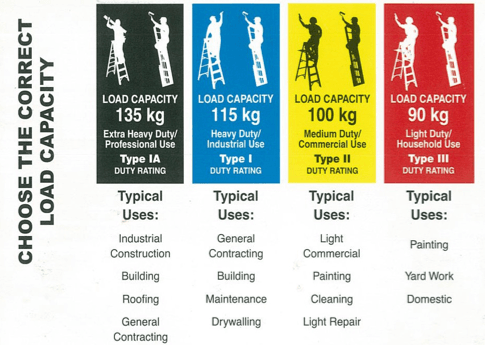
Ladder Ratings
Enforcement
Constant awareness of and respect for fall hazards, and compliance with all safety rules are considered conditions of employment. The supervisor or foreman, as well as individuals in the Safety Department, reserve the right to issue disciplinary warnings to employees, up to and including termination, for failure to follow the guidelines of this program.